

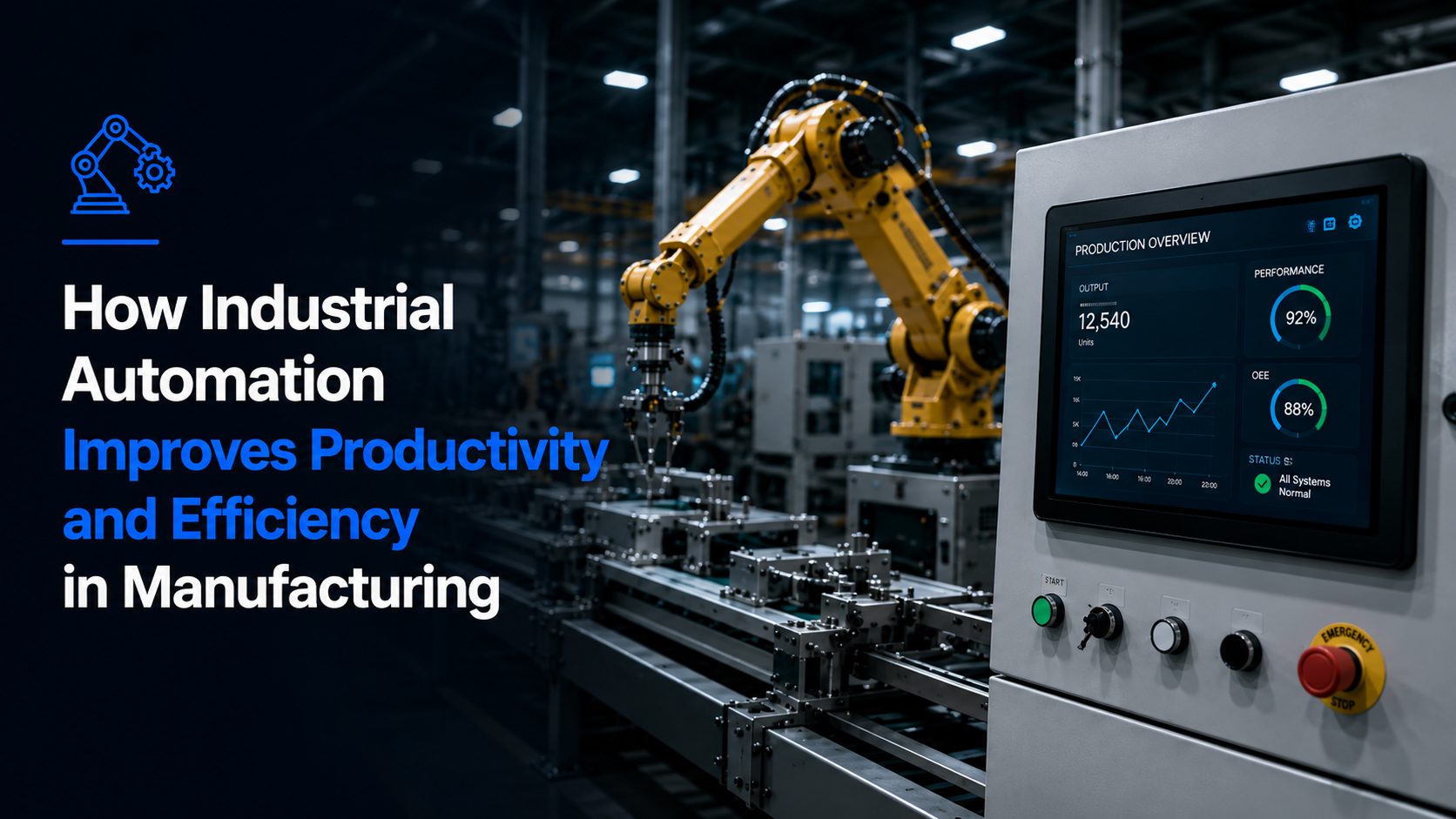
Factories rarely struggle because of one massive problem. More often, it is the smaller issues that quietly eat away at performance. A machine waits for approval. An operator spends extra time making adjustments. A conveyor stops for a few minutes. Nobody panics because of these delays. They seem harmless. Until someone adds them up.
A few minutes lost here and there can eventually turn into hours of reduced production every month. This reality explains why manufacturers are paying so much attention to automation today. It is not only about faster machines. It is about creating smoother operations where processes flow without unnecessary interruptions.
Modern businesses want better quality, predictable output, and fewer surprises. That is exactly where industrial automation makes a difference, helping facilities improve efficiency while creating more stable and productive working environments.
What is Industrial Automation
Walk through a modern manufacturing plant, and you will notice something interesting. People are still everywhere.
Engineers monitor systems. Operators supervise production. Maintenance teams inspect equipment. Automation has not replaced people. It has changed how they work. Instead of spending hours performing repetitive tasks, employees focus on activities that require judgment, troubleshooting, and decision-making. The repetitive work is handled by technology.
Think about a packaging line producing thousands of units every shift. Speed adjustments, inspection routines, conveyor movement, and process monitoring happen continuously. Expecting operators to manage every small action manually would be difficult and inefficient.
Automation allows machines, drives, sensors, and controllers to coordinate these activities automatically. Modern facilities rely heavily on industrial automation and control systems (IACS), which include control platforms such as Programmable Logic Controllers (PLCs) and Distributed Control Systems (DCS). These systems help maintain consistency while reducing unnecessary manual intervention across daily operations.
Benefits of Industrial Automation
The impact of automation often appears gradually. Facilities begin noticing fewer interruptions, smoother production flow, and more predictable results. Over time, these improvements become difficult to ignore.
Production Keeps Moving
A machine does not become distracted during a long shift. It does not slow down because it has performed the same task hundreds of times already. Automated systems follow instructions consistently. This helps production continue at a steady pace throughout the day.
A few seconds saved during each cycle may seem insignificant. Across thousands of cycles, however, those savings become meaningful.
Consistency Becomes Easier to Achieve
Ask a quality manager about production challenges, and inconsistency usually enters the conversation sooner or later.
Different shifts often produce slightly different results. Small adjustments create variation. Different shifts often produce slightly different results. Small adjustments create variation. Automation reduces process variability by maintaining controlled operating parameters, provided systems are properly calibrated, configured, and supported by accurate sensor inputs. This makes it easier to achieve repeatable quality standards.
Waste Starts Becoming Visible
One of the surprising things about automation is how quickly it exposes inefficiencies.
Material losses that once went unnoticed become measurable. Process deviations become easier to identify. Equipment running outside optimal conditions becomes more obvious. Once these issues are visible, improvements become easier to implement.
Safety Improves Without Constant Intervention
Industrial environments contain moving equipment, electrical systems, elevated temperatures, and repetitive tasks. Some risks cannot be eliminated entirely. Others can be reduced significantly.
Automation improves safety not only by enabling personnel to supervise operations from safer locations but also through the use of safety PLCs, machine interlocks, emergency stop systems, and compliance with functional safety standards such as IEC 61508 and IEC 62061. Together, these measures help reduce operational risks while supporting safe and reliable plant operation.
Decisions Happen Faster
Years ago, managers often reviewed production reports after a shift ended. By then, any problem had already affected output.
Today, automated systems provide near real-time monitoring through supervisory platforms such as SCADA and Manufacturing Execution Systems (MES). Operators can view alarms, equipment status, production performance, and process trends immediately, allowing quicker responses to changing operating conditions.
Types of Industrial Automation
Not every factory operates the same way. A facility producing identical products all year long requires a different approach than one manufacturing several variations every week. That is why automation systems are generally grouped into different categories.
Fixed Automation
Some production lines are designed for one purpose and one purpose only.
Certain high-volume automotive manufacturing processes, such as body welding and transfer lines, provide good examples of fixed automation. These operations remain largely unchanged for extended periods, allowing equipment to operate with exceptional speed and efficiency. While flexibility is limited, productivity can be remarkably high.
Programmable Automation
Other facilities need room for change.
Batch production environments often manufacture different products using the same equipment. Instead of rebuilding the system entirely, operators modify programs to suit changing production requirements. This flexibility makes programmable automation valuable across many industries.
Flexible Automation
Market demand does not stand still.
Customers want new products. Specifications change. Production schedules evolve. Flexible automation refers to manufacturing systems capable of producing different products with minimal changeover time, often using programmable robotics, CNC machines, and adaptable control systems. This enables manufacturers to respond efficiently to changing production requirements without extensive equipment modifications.
Integrated Automation
Modern factories increasingly rely on connected operations rather than isolated machines.
Integrated automation connects field devices such as sensors and actuators with control systems including PLCs and DCS, as well as supervisory platforms such as SCADA and MES. This enables seamless data flow across field, control, supervisory, and enterprise levels, providing better coordination, visibility, and decision-making throughout the operation.
Future of Industrial Automation
The discussion on automation is evolving. Several years ago the issue was primarily productivity. Today the topics are also shifting to data, connectivity, sustainability and intelligence. The technology keeps changing, and manufacturers are adapting to it as well.
Equipment Will Become More Predictive
Unexpected breakdowns are among the biggest challenges manufacturers face. Today, vibration, temperature, load, and performance trends are continuously monitored in modern systems. In many cases, condition monitoring combined with advanced analytics enables early fault detection and predictive maintenance, allowing potential issues to be addressed before they develop into equipment failures.
Data Will Gain More Value
Factories generate large volumes of operational data every day, much of which historically remained underutilised because of limited data integration and analytics capabilities. This is changing rapidly. Production data is increasingly being analysed to improve operational efficiency, identify performance trends, optimise maintenance activities, and support better-informed manufacturing decisions.
Connectivity Will Continue Expanding
The relationship between industrial automation and digital transformation continues to strengthen. Production equipment now communicates with enterprise systems, analytics platforms, and operational dashboards. Information no longer stays trapped within individual departments, creating better visibility across the entire business. These developments are closely aligned with Industry 4.0 initiatives, where connected devices, industrial communication networks, cloud platforms, and advanced analytics work together to improve manufacturing performance.
Skills Will Matter More Than Ever
Technology can be more intelligent but people are still needed. The need for individuals who have industrial automation training is growing as automation systems get more complex. There is a need for people who can comprehend modern equipment, communication systems, and integrated control systems in industries.
Sustainability Will Influence Future Investments
Energy efficiency is becoming a priority for manufacturers worldwide. Automation supports this goal by helping facilities monitor consumption, optimise equipment operation, and reduce unnecessary waste. Future investment decisions will increasingly consider both productivity improvements and environmental impact.
Conclusion
The growing connection between industrial automation and digital transformation is pushing industries toward smarter and more connected operations. Businesses now have access to insights and capabilities that were difficult to imagine not very long ago. With the adoption of Industry 4.0 technologies, integrated industrial automation and control systems (IACS), and data-driven decision-making, manufacturers are improving productivity, operational visibility, and long-term efficiency while building more resilient production environments.
Lauritz Knudsen Electrical & Automation supports this journey. It offers technologies such as PLCs, HMIs, AC Drives, Soft Starters, and Temperature Monitoring Systems. These are designed to help manufacturers build efficient, reliable, and future-ready operations.