

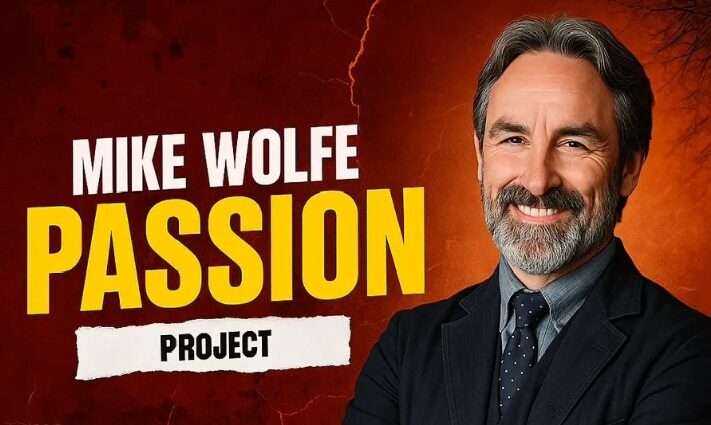
Most people picture mike wolfe passion project climbing through cobwebbed barns, haggling over rusty motorcycles, and loading a van with forgotten relics of American industry. That image is accurate as far as it goes. But it stops at the surface. Underneath every episode of American Pickers, beneath every handshake deal and dusty discovery, runs a current of purpose that Wolfe has been building toward for his entire adult life. He calls it, simply, his passion project — and in 2026, it has grown into one of the most quietly remarkable preservation efforts in the country.
This is not a side hustle or a celebrity vanity endeavor. It is a coherent, decades-long philosophy about what American history is worth, who gets to keep it, and what happens to a community when its physical memory disappears. Wolfe grew up in Joliet, Illinois, without much. What he had was an eye for objects others discarded. He learned early that a broken bicycle, properly seen, is not trash — it is a puzzle, a story, a small piece of someone else’s life. That childhood instinct never left him. It simply scaled up.
From Picking Bikes to Picking Towns
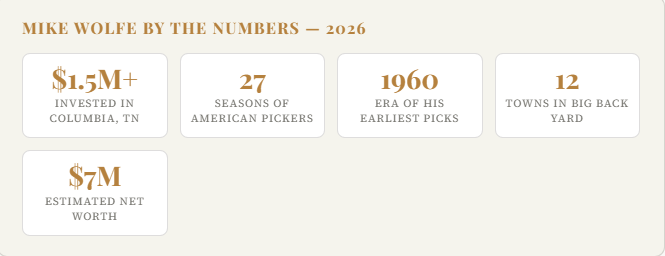
Wolfe’s origin story is deceptively simple. As a boy in the 1970s, he combed his neighborhood for discarded bicycles, fixed them, and sold them. He was not yet ten years old and already understood the relationship between neglect and value — that things abandoned by others often hold exactly the worth others failed to see. By his own account, he was “picking” by age four, a compulsion that would eventually make him one of the most recognized figures in American antique culture.
In 2000, he formalized that instinct by opening Antique Archaeology in LeClaire, Iowa — a small river town on the Mississippi that most Americans had never heard of. The shop was not just a retail store. It was a curatorial statement: the everyday objects of working-class American life deserved a permanent home and an audience. LeClaire would become the blueprint for everything that followed. The store brought visitors, visitors brought attention, attention brought investment, and investment brought life back to a town that had been quietly fading.
“Every object has a story — you just have to listen.”Mike wolfe passion project
When American Pickers premiered on the History Channel in January 2010, it drew 3.1 million viewers on its opening night — the highest-rated History Channel debut since Ice Road Truckers in 2007. Overnight, Wolfe became a household name. But the show was never, for him, the destination. It was the megaphone. The platform through which a philosophy about preservation, storytelling, and community could reach an audience of millions who might otherwise never encounter it.
What the Passion Project Actually Is
The term “mike wolfe passion project” gets thrown around loosely in celebrity culture. For Wolfe, it describes something precise: a three-pillar mission built around historic building restoration, community economic revitalisation, and cultural storytelling. These are not separate activities. They are interdependent — each one feeding the others in a cycle that Wolfe has refined over twenty-five years of practice.
Historic structures, in his framework, are not monuments to be preserved behind glass. They are assets waiting to be put back to work. A restored storefront draws foot traffic. A revived gathering space creates jobs. A working guesthouse tells visitors a story about a place that a hotel chain never could. The past, in Wolfe’s philosophy, should be lived with rather than merely observed.
Columbia, Tennessee: The Beating Heart
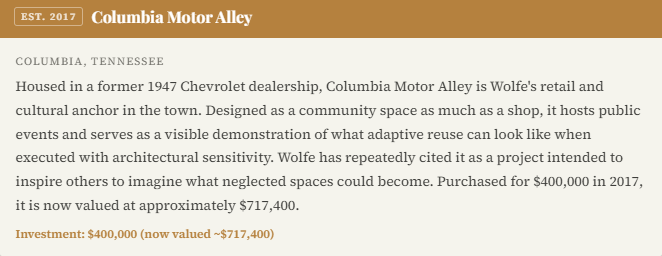
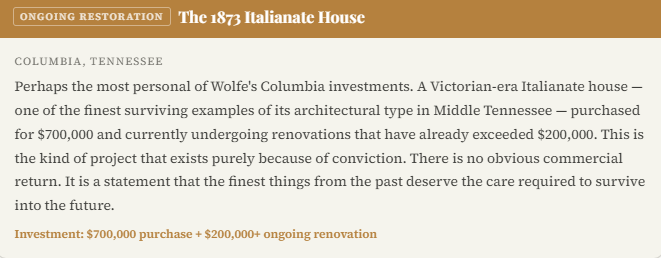
If you want to understand what mike wolfe passion project looks like in physical form, go to Columbia, Tennessee. Known as the “Antique Capital of Tennessee,” Columbia sits in Mary County, roughly an hour south of Nashville. It has the bones of a significant American town — Italianate architecture, brick-lined streets, a courthouse square with real character — and for years it had been losing the battle against neglect, population drift, and the slow erosion that affects so many mid-sized Southern cities.
Wolfe began investing there deliberately. He has described Columbia as possessing “tremendous history, incredible architecture, and just so many nooks and crannies.” His total investment in the town now exceeds $1.5 million, spread across several properties that form an interconnected vision of what Main Street preservation can accomplish when someone commits to it seriously rather than superficially.
LeClaire, Iowa: Where It All Started
While Columbia gets most of the recent attention, the original laboratory for Wolfe’s preservation model remains LeClaire, Iowa. When he opened Antique Archaeology there in 2000, LeClaire was a quiet river town most Americans couldn’t find on a map. Today it is a heritage travel destination. The store drew fans, fans generated tourism, tourism attracted investment, and the town came alive again. The LeClaire model is the proof of concept that underwrites everything Wolfe has done since.
His original flagship Antique Archaeology store in LeClaire remains open as of 2026 — and it remains the heart of his picking operation. The Nashville branch, which he opened and grew into a $900,000-per-year revenue operation over fifteen years, was closed in April 2025. Wolfe’s explanation was characteristically direct: he wanted to be closer to his daughter and his mother, and to concentrate his preservation energy on Columbia. The closure of Nashville was not a retreat. It was a reallocation.
Nashville’s Big Back Yard: A Regional Vision
Beyond the property-by-property work, Wolfe has been the most prominent advocate for a broader regional initiative called Nashville’s Big Back Yard. Launched in 2020, the project spotlights approximately twelve small towns spread along a hundred-mile stretch of the historic Natchez Trace Parkway between Nashville, Tennessee and Muscle Shoals, Alabama.
The initiative’s central argument is straightforward: the communities between the famous cities are exactly where affordable, meaningful, historically rooted American life is still possible. Remote work has made proximity to major urban centers less essential than at any previous moment in modern history. Big Back Yard makes the case that towns with intact Main Streets, open land, regional history, and genuine community character offer something that sprawling metropolitan suburbs cannot. Wolfe is not just endorsing this idea — he is living it.
The Timeline: A Career of Compounding Purpose
1964
Born in Joliet, Illinois. Grows up with limited means but an innate compulsion to find value in discarded objects. Begins picking at age four.
2000
Opens Antique Archaeology in LeClaire, Iowa. Transforms his picking hobby into a curatorial business and begins the LeClaire revival model that would define his approach.
January 2010
American Pickers premieres on the History Channel to 3.1 million viewers — the network’s highest-rated debut in years. The show becomes Wolfe’s national platform for preservation philosophy.
2017
Acquires Columbia Motor Alley in Columbia, Tennessee — the first major signal of his commitment to that city’s revival. The former 1947 Chevrolet dealership becomes an anchor for his downtown investment.
2020
Launches Nashville’s Big Back Yard — a regional movement promoting twelve small towns between Nashville and The Shoals as genuine alternatives to expensive urban living.
September 2022
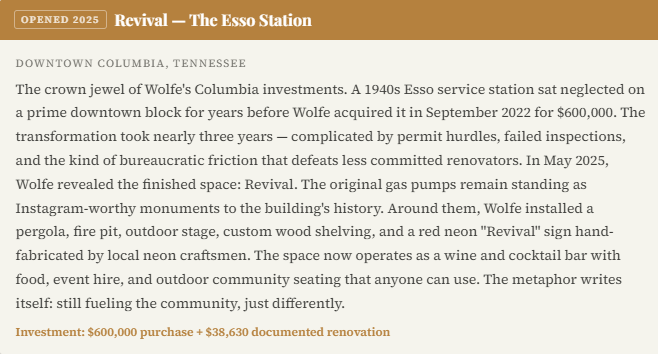
Purchases the historic Esso station in downtown Columbia for $600,000. The transformation into Revival would take three years, facing permit complications and multiple inspections.
April 2025
Closes Antique Archaeology Nashville after nearly fifteen years, citing desire to be near family and refocus energy on Columbia preservation and LeClaire. The Nashville store had generated approximately $900,000 in annual revenue.
May 2025
Revival opens to the public. The completed Esso station transformation — featuring fire pit, pergola, neon signage, outdoor stage — becomes the most visible symbol of his Columbia mission. Fan reaction on social media is immediate and overwhelming.
July 2025
American Pickers Season 27 premieres. Wolfe continues as creator, executive producer, and star alongside co-host and brother Rob Wolfe, Danielle Colby, and Jersey Jon Szalay.
February 2026
History’s Greatest Picks with Mike Wolfe begins airing on the History Channel — a new series exploring legendary artifacts and treasures across American history, confirming his continued relevance in history-based entertainment.
The Philosophy Behind the Picks
What separates Wolfe from decorators who appreciate antiques, or developers who buy historic buildings and gut them, is a consistent and articulate worldview. He sees objects not as commodities but as evidence — proof that ordinary people lived, worked, built things, and cared about craft. The motorcycle in the barn is not just a vehicle. It is a record of someone’s ambition, their taste, their moment in American industrial history. To let it rot is to let that record dissolve.
The same logic applies to buildings. A 1940s Esso station that gets demolished takes with it not just bricks but a specific relationship between a community and its infrastructure — a material memory of how people moved, fueled, and connected in a particular era. Wolfe’s response to that loss is not nostalgia. It is action. He buys the building, respects its bones, and finds a new function that lets the old character survive into the present.
“He’s not building a brand. He’s building permanence.”— Assessment of Wolfe’s Columbia investments, 2025
His collection interests are revealing in this regard. Wolfe has a particular passion for antique motorcycles, air-cooled Volkswagens, old bicycles, and penny-farthings. These are not arbitrary obsessions. Each category represents a chapter in American and European transportation and cultural history — the stories of how ordinary people moved through the world before mass homogenization. They are the kinds of objects that disappear quickly when no one decides to care about them.
Economic Ripple Effects
Skeptics might ask whether one television personality’s real estate investments can genuinely move the needle for a struggling town. The evidence from both LeClaire and Columbia suggests the answer is yes — not because of scale alone, but because of the signal Wolfe’s investment sends. When a nationally recognized figure commits serious money and personal time to a community, it tells other investors, business owners, and potential residents that the place is worth betting on.
In LeClaire, the presence of Antique Archaeology turned a quiet river town into a heritage travel destination. In Columbia, locals now describe the downtown as “alive again” — with foot traffic, tourism, and new business openings following in the wake of Wolfe’s visible commitment. Revival alone, as a public gathering space with event programming and food service, has created jobs and given residents a community anchor they previously lacked.
Wolfe is explicit about this economic dimension. He sees historic buildings not as passive cultural artifacts but as active contributors to local economies. The restoration of a storefront is not charity — it is investment in the infrastructure that makes community life possible. By treating preservation as economically rational rather than sentimentally indulgent, he makes the case accessible to audiences who might otherwise dismiss it as backward-looking.
2026: Reinvention and Legacy
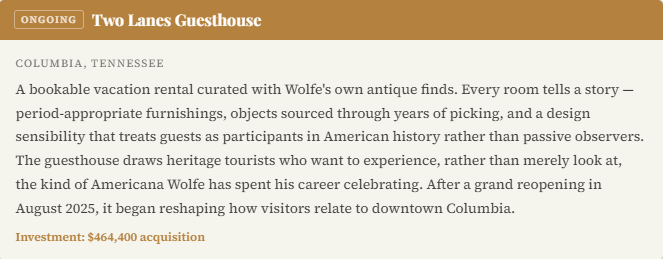
By June 2026, mike wolfe passion project occupies an interesting position. He remains the face of American Pickers — now in its twenty-seventh season — and the creator of History’s Greatest Picks, a new series that demonstrates his continued appetite for television storytelling. At the same time, his identity has expanded well beyond any single show. The Columbia investments are maturing. Revival is operating. Two Lanes Guesthouse is welcoming guests. The Big Back Yard movement continues to draw attention to the communities he believes in.
Also Read More : Mike wolfe passion project
His personal life has also shaped the direction of the project. The closure of Antique Archaeology Nashville in April 2025 — deliberately chosen over continued revenue — reflects a man making decisions based on proximity to family and the depth of commitment to specific places rather than the breadth of commercial opportunity. He has a daughter, Charlie Reece Wolfe, and has spoken openly about wanting her to inherit the same values that shaped his own trajectory: hard work, respect for the past, and the conviction that things worth saving are worth the effort they require.