

The Origins
Before July 2023, inter miami vs tigres uanl timeline existed on entirely separate footballing planets. Miami was a three-year-old MLS franchise still searching for identity, while Tigres were an eight-time Liga MX champion and 2020 CONCACAF Champions League winner — a titan of the Mexican game. That distance collapsed overnight when David Beckham’s club signed Lionel Messi, instantly transforming Inter Miami into the most commercially potent club in North American history and placing the two teams on a collision course.
The expanded Leagues Cup, relaunched in a World Cup-style format with 47 MLS and Liga MX clubs competing for CONCACAF Champions Cup spots, provided the perfect stage. Two clubs separated by language, tradition, and football philosophy were about to write one of the continent’s most compelling new sporting narratives.
Match-by-match inter miami vs tigres uanl timeline
August 3, 2024 · Leagues Cup Group Stage
Tigres Announce Themselves in Houston
Tigres UANL 2–1 Inter Miami CF — NRG Stadium, Houston (att. 47,000+)
This was the defining first chapter. Tigres midfielder Juan Brunetta opened the scoring with a powerful left-footed strike from distance in the 18th minute, setting the tone for what would be an evening dominated by Mexican tactical discipline. Miami briefly levelled from the penalty spot — Leonardo Campana’s goal drawing him level with Gonzalo Higuaín as the club’s all-time top scorer with 29 goals — but Tigres midfielder Juan Pablo Vigón settled the match with a clinical volley in the 84th minute. Luis Suárez’s frustration boiled over in stoppage time, earning a yellow card for dissent. Tata Martino admitted afterwards that his team had been overwhelmed by the Mexicans’ intensity. It was a statement from Liga MX: star power alone does not win football matches.
August 20, 2025 · Leagues Cup Quarterfinal
Suárez’s Two Penalties Seal Dramatic Revenge
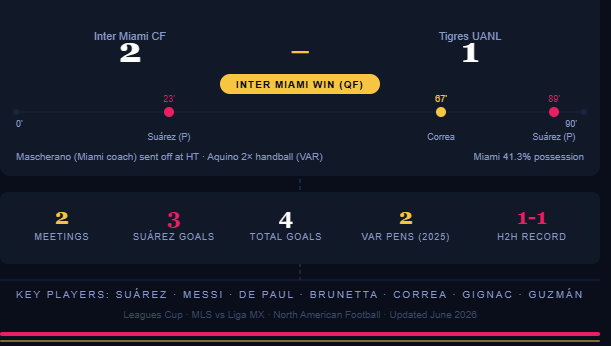
Inter Miami CF 2–1 Tigres UANL — Chase Stadium, Fort Lauderdale
Fourteen months later, the stakes had risen dramatically. This was a knockout fixture — winner advances, loser goes home. Miami coach Javier Mascherano was sent off at half-time for protesting a stoppage time decision, forced to watch the second half from the tunnel. In his absence his team delivered. Luis Suárez converted a first-half penalty after a Javier Aquino handball to give Miami the lead. Argentine forward Ángel Correa — who had scored four goals in Leagues Cup Phase One — equalised for Tigres in the 67th minute, arriving at the near post to beat goalkeeper Oscar Ustari. Then came the decisive moment: VAR spotted a second Aquino handball in the 89th minute and Suárez, ice-cold, buried the penalty. Miami held on despite Edgar López heading against both posts in added time. The equaliser would not come.
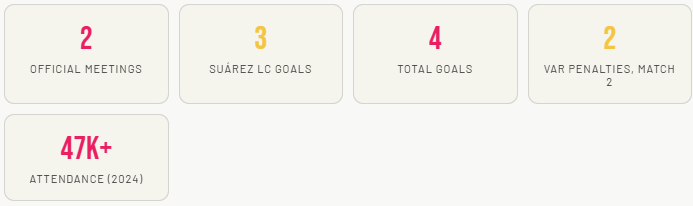
Key Statistics
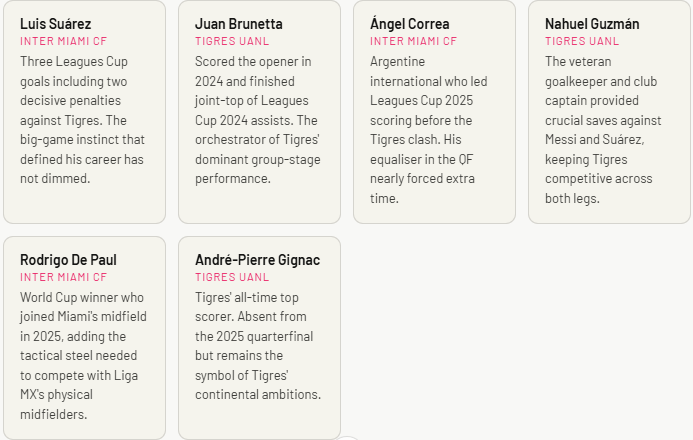
Players Who Defined the Rivalry
The Broader Significance
Every Inter Miami–Tigres match transcends the scoreline. These fixtures have become an annual referendum on which league — MLS or Liga MX — is progressing faster. Tigres’ 2024 win underscored that Mexican clubs retain a structural edge in midfield organisation and physical intensity. Miami’s 2025 revenge demonstrated that MLS clubs, armed with global recruitment budgets and marquee signings, are genuinely capable of eliminating Liga MX opposition in knockout football.
The 2024 CONCACAF Champions Cup added another dimension: both clubs were competing in that tournament simultaneously but were eliminated before meeting — Miami by Monterrey in the quarterfinals, Tigres by Columbus Crew on penalties at the same stage. The near-miss only intensified fan appetite for a third competitive encounter. With the Leagues Cup expanding and CONCACAF competition growing in profile, a third meeting feels inevitable rather than merely possible.
Tactical Analysis
Across both matches, a clear tactical picture has emerged. Tigres consistently seek to dominate the physical midfield battle, using the experience of Guido Pizarro and Fernando Gorriarán to disrupt Miami’s fluid attacking transitions. In 2024 this strategy worked perfectly. Miami held just 41.3% possession in the 2025 quarterfinal and were outrun for large portions of the contest — yet won the match through individual brilliance and VAR-assisted penalties rather than sustained territorial dominance.
Miami’s strength lies in the spaces between organised blocks, where Messi’s vision, Suárez’s movement, and Correa’s burst of acceleration can produce moments of decisive quality. The introduction of Rodrigo De Paul has given Mascherano a holding midfielder capable of protecting the back four without sacrificing the speed of vertical transitions.
“The inter miami vs tigres uanl timeline may still be short, but it already reflects the evolution of football in North America. Each meeting brings tactical brilliance, passionate fan support, and unforgettable moments.”
— The emerging narrative of MLS vs Liga MX
What Comes Next
As of June 2026, the head-to-head record stands perfectly balanced at one win apiece. Both clubs enter the year strengthened — Miami continuing to attract South American talent while Tigres maintain their Liga MX dominance through consistent investment. The Leagues Cup, CONCACAF Champions Cup, and the growing Club World Cup landscape all present potential venues for a third chapter.
One truth is already established: when these two clubs meet, the result is never predictable. From Brunetta’s thunderbolt in Houston to Suárez’s ice-cold double in Fort Lauderdale, the Inter Miami–Tigres rivalry has compressed remarkable drama into just two games. North American football is better for it — and the third match, whenever it arrives, will be unmissable.